> ## Documentation Index
> Fetch the complete documentation index at: https://docs.gelato.cloud/llms.txt
> Use this file to discover all available pages before exploring further.
# Track & Debug Requests
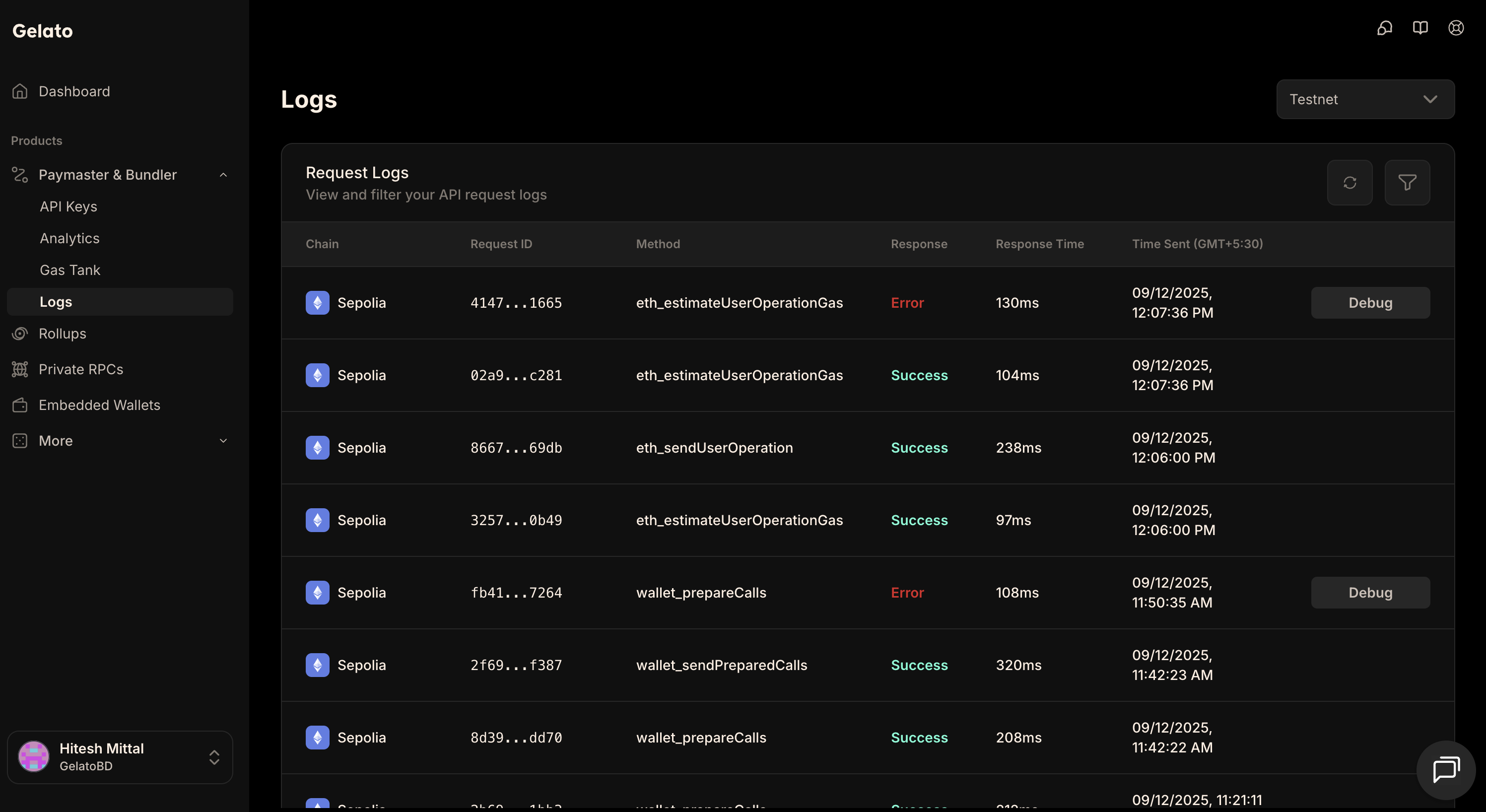
We’ve introduced [UI Logs](https://app.gelato.cloud/logs) for Gelato Bundler endpoints!
* You can now track all your requests directly in the dashboard, and easily **debug failed requests** using built-in Tenderly simulations.
* Additionally, you can get info such as **response time, request body, response body**, and more.
## Debugging Failed Requests Using UI Logs
You can use the **UI logs** to debug failed requests directly from the Gelato app. These logs are available in the [Paymaster & Bundler](https://app.gelato.cloud/logs) section of the dashboard.
 ### Steps to Debug
1. Go to the **logs** section and locate your failed relay request.
2. On the right side of the log entry, click the **Debug** button.
3. A new option, **View Debug**, will appear. Click it.
4. This will open a **Tenderly simulation**, which you can use to analyze and debug the failed request.
## Using Status Endpoint
If you call the `relayer_sendTransaction` or `relayer_sendTransactionSync` API endpoints, the returned `id` can also be used to track the status of the transaction through Gelato's infrastructure like this:
```bash theme={null}
curl --request POST \
--url https://api.gelato.cloud/rpc \
--header 'Content-Type: application/json' \
--header 'X-API-Key: YOUR_API_KEY' \
--data '{
"id": 1,
"jsonrpc": "2.0",
"method": "relayer_getStatus",
"params": {
"id": "0x0e670ec64341771606e55d6b4ca35a1a6b75ee3d5145a99d05921026d1527331",
"logs": false
}
}'
```
### Response
```json theme={null}
{
"jsonrpc": "2.0",
"id": 1,
"result": {
"id": "0x0e670ec64341771606e55d6b4ca35a1a6b75ee3d5145a99d05921026d1527331",
"status": 200,
"message": "Transaction included",
"receipt": {
"transactionHash": "0x...",
"blockNumber": 12345678,
"gasUsed": "21000"
}
}
}
```
## Status Codes
The `relayer_getStatus` endpoint returns numeric status codes:
| Code | Status | Description |
| ----- | --------- | ----------------------------------------------------------------------- |
| `100` | Pending | Transaction is queued and waiting to be processed |
| `110` | Submitted | Transaction has been submitted to the network |
| `200` | Included | Transaction was successfully included in a block |
| `400` | Rejected | Transaction was rejected (invalid parameters, insufficient funds, etc.) |
| `500` | Reverted | Transaction was included but execution reverted |
### Using Status Codes in Code
When using the SDK, `sendTransactionSync` returns the receipt directly and throws on failure:
```typescript theme={null}
const receipt = await relayer.sendTransactionSync({ ... });
console.log(`Success! Hash: ${receipt.transactionHash}`);
```
When using the API directly, check against the numeric values:
```typescript theme={null}
const data = await response.json();
const status = data.result.status;
// Terminal states
if (status === 200) {
console.log('Transaction included');
} else if (status === 400) {
console.log('Transaction rejected');
} else if (status === 500) {
console.log('Transaction reverted');
}
// Non-terminal states (keep polling)
else if (status === 100 || status === 110) {
console.log('Transaction pending...');
}
```
### Steps to Debug
1. Go to the **logs** section and locate your failed relay request.
2. On the right side of the log entry, click the **Debug** button.
3. A new option, **View Debug**, will appear. Click it.
4. This will open a **Tenderly simulation**, which you can use to analyze and debug the failed request.
## Using Status Endpoint
If you call the `relayer_sendTransaction` or `relayer_sendTransactionSync` API endpoints, the returned `id` can also be used to track the status of the transaction through Gelato's infrastructure like this:
```bash theme={null}
curl --request POST \
--url https://api.gelato.cloud/rpc \
--header 'Content-Type: application/json' \
--header 'X-API-Key: YOUR_API_KEY' \
--data '{
"id": 1,
"jsonrpc": "2.0",
"method": "relayer_getStatus",
"params": {
"id": "0x0e670ec64341771606e55d6b4ca35a1a6b75ee3d5145a99d05921026d1527331",
"logs": false
}
}'
```
### Response
```json theme={null}
{
"jsonrpc": "2.0",
"id": 1,
"result": {
"id": "0x0e670ec64341771606e55d6b4ca35a1a6b75ee3d5145a99d05921026d1527331",
"status": 200,
"message": "Transaction included",
"receipt": {
"transactionHash": "0x...",
"blockNumber": 12345678,
"gasUsed": "21000"
}
}
}
```
## Status Codes
The `relayer_getStatus` endpoint returns numeric status codes:
| Code | Status | Description |
| ----- | --------- | ----------------------------------------------------------------------- |
| `100` | Pending | Transaction is queued and waiting to be processed |
| `110` | Submitted | Transaction has been submitted to the network |
| `200` | Included | Transaction was successfully included in a block |
| `400` | Rejected | Transaction was rejected (invalid parameters, insufficient funds, etc.) |
| `500` | Reverted | Transaction was included but execution reverted |
### Using Status Codes in Code
When using the SDK, `sendTransactionSync` returns the receipt directly and throws on failure:
```typescript theme={null}
const receipt = await relayer.sendTransactionSync({ ... });
console.log(`Success! Hash: ${receipt.transactionHash}`);
```
When using the API directly, check against the numeric values:
```typescript theme={null}
const data = await response.json();
const status = data.result.status;
// Terminal states
if (status === 200) {
console.log('Transaction included');
} else if (status === 400) {
console.log('Transaction rejected');
} else if (status === 500) {
console.log('Transaction reverted');
}
// Non-terminal states (keep polling)
else if (status === 100 || status === 110) {
console.log('Transaction pending...');
}
```